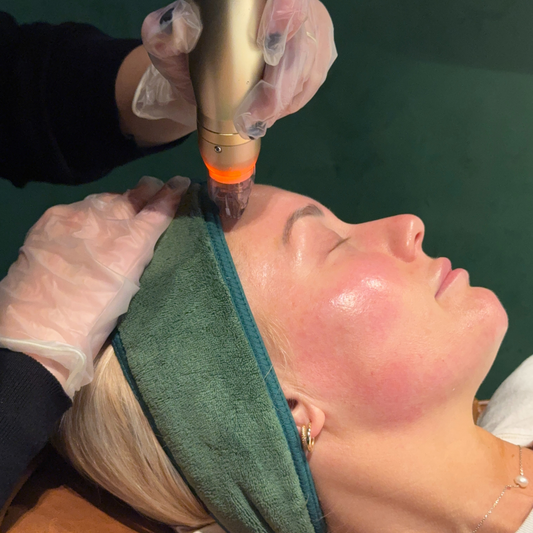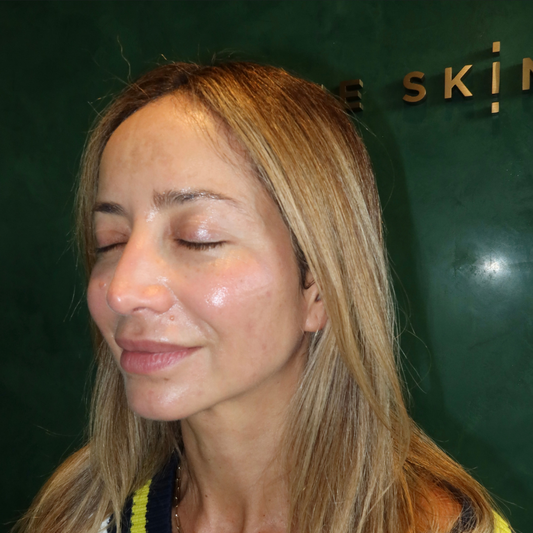

The difference between congested skin vs acne is inflammation. Congestion is a build-up of oil and dead skin cells sitting in your pores as blackheads and small skin-coloured bumps. Acne is what happens when those blocked pores become inflamed and turn into red, tender spots. Once you know which one you've got, you know what your skin needs next.
Here's how to read your skin, and how we treat each one at The Skin Bar.
Key takeaways
- Congestion is non-inflamed: blackheads (open comedones) and closed comedones that sit flat or slightly raised and don't hurt.
- Acne is inflamed: red papules, pus-filled pustules and deeper cysts that feel tender, warm or sore to touch.
- Herbal B Peel is where we start for congestion and breakouts: six fortnightly sessions with no visible peeling.
- Skin needling is the next step, a 3-session program that refines pores and texture, with redness settling in 24 to 48 hours.
| Congested skin | Acne | |
|---|---|---|
| What it looks like | Blackheads, small skin-coloured bumps, rough texture | Red bumps, spots with a white or yellow head, deeper lumps |
| How it feels | Bumpy or gritty, not sore | Tender, warm or painful |
| Inflamed? | No | Yes |
| Common areas | Nose, chin, forehead, T-zone | Face, jawline, chest, back |
| Main cause | Oil and dead skin cells blocking pores | Blocked pores that become inflamed |
| What helps in clinic | Herbal B Peel to clear, then skin needling to refine | Consultation first, Herbal B Peel and blue LED to calm, then skin needling |
| When to see a professional | When it keeps coming back or your routine stops shifting it | Painful, deep or scarring breakouts (see your GP or dermatologist) |
What is skin congestion?
Skin congestion is a build-up of oil (sebum) and dead skin cells inside your pores. It shows up as blackheads, which are open at the surface and look dark, and closed comedones, the small skin-coloured bumps often mistaken for whiteheads or "texture". Because congestion isn't inflamed, it rarely feels sore.
Congestion usually comes in three forms:
- Blackheads (open comedones): a pore plug that's open to the air and darkens at the surface.
- Closed comedones: a plug sealed under a thin layer of skin, so it sits as a small, firm bump.
- Rough, uneven texture: lots of small plugs close together, most noticeable when light hits your skin side-on.
It tends to cluster where oil production is highest, across the nose, chin and forehead.
Congestion responds well to a steady routine and regular treatments. For most clients, that starts with a Herbal B Peel.
What is acne?
Acne is an inflammatory skin condition that starts in the same place as congestion: a blocked pore. When bacteria multiply inside that pore, the area becomes inflamed and you see red bumps (papules), pus-filled spots (pustules) or deeper, sore lumps (nodules and cysts). Congestion is the starting point. Acne is what happens when it inflames.
So is skin congestion a type of acne? Clinically, heavy congestion is often called comedonal acne, the mild, non-inflamed end of the acne spectrum. Most people use "acne" to mean the red, inflamed spots, and that's how we use it here.
Inflamed breakouts can leave post-inflammatory hyperpigmentation (PIH), the flat brown or pink marks that stay after a spot heals. Calming inflammation early helps keep those marks to a minimum. See how our Combination Skin Needling & Herbal B Peel treatment series supports breakout-prone skin.
Congested skin vs acne: how to tell the difference
The fastest way to tell congested skin from acne is colour and touch. Congestion matches your skin tone or shows as dark dots, feels rough or bumpy, and doesn't hurt. Acne looks red or has a visible head, feels tender or warm, and can leave marks behind. Plenty of people have both at the same time.
Check your skin against these four signs:
- Colour: skin-toned bumps or dark dots point to congestion. Red or pink points to acne.
- Feel: gritty and not sore is congestion. Sore, warm or swollen is acne.
- Speed: congestion builds slowly over weeks. Acne spots can appear overnight.
- Aftermath: congestion clears without a trace. Inflamed acne can leave PIH.
Closed comedones vs acne is where most people get stuck. Closed comedones are small, firm and flesh-coloured, with no redness and no head. If you can feel them more than see them, it's congestion.
[GAP: senior therapist quote on how they read congestion vs acne at consult]
What causes congested skin?
Congested skin happens when oil and dead skin cells build up faster than your skin can clear them. Extra oil production, slower cell turnover, heavy or pore-clogging products and hormonal shifts all add to the build-up. The pore fills, plugs and stays blocked until it's cleared.
The most common contributors:
- Oil production: more sebum means more material to plug the pore.
- Cell turnover: when dead cells shed slowly, they mix with oil and stick.
- Product choice: rich, occlusive or pore-clogging formulas can add to the load. Non-comedogenic products are made to avoid this.
- Hormones: hormonal changes can lift oil production, which is why congestion often shifts with your cycle.
Your therapist looks at which of these apply to you and builds your routine around them, so pores stay clear between treatments.
"Firstly, what we will do is have a thorough skin consultation. We'll take a holistic approach when it comes to hormonal acne. So, talking about diet, lifestyle factors, stress factors, go into what you're using on your skin at home, and then going into more treatment planning."
- Sophie, Mermaid Beach clinic manager
Can congestion turn into acne?
Yes, congestion can turn into acne. A blocked pore is the starting point for every acne spot, so when congestion sits for a long time, bacteria have more places to multiply and inflammation can follow. Keeping pores clear is the most reliable way to keep breakouts from building.
So we treat congestion early. A salicylic exfoliant at home stops plugs settling in, and a Herbal B Peel program clears what's already there. Fewer blocked pores means fewer spots that can inflame. From there, skin needling keeps building, refining pores and texture across a program.
How do you treat skin congestion?
Skin congestion clears best with a Herbal B Peel program backed by a simple daily routine. The peel lifts the build-up sitting in your pores, your homecare keeps new plugs from forming, and skin needling takes over once your skin is clear. Every session builds on the last.
Start with Herbal B Peel. It's a plant-based peel built for breakouts and congestion. A blend of pure herbs is massaged into the skin, where tiny herbal particles create a needling effect and keep working for up to 48 hours. You leave glowing, with no visible peeling. Expect some warmth and prickling for a few hours afterwards. It suits sensitive skin and every skin type. The program runs as six sessions, fortnightly, then every 2 to 4 weeks.

Support it at home. Every Skin Bar client leaves with a written homecare prescription built on six steps: cleanse, tone, exfoliate, correct, hydrate and protect. For congested skin, that usually includes a salicylic toner, a serum for oily skin and a daily non-comedogenic SPF.
Add-ons your therapist may suggest:
- Blue LED: targets acne bacteria, balances oil and calms breakouts. Add LED light therapy to any treatment.
- K-Beauty Spicules (Congestion & Acne): a resurfacing treatment every 4 weeks, often alternated with Herbal B Peel or skin needling.
Browse every congestion and acne treatment in one place.
Does skin needling help congested skin?
Yes. Skin needling treats congestion, open pores, uneven texture and acne scarring, and it's where your program goes once Herbal B Peel has cleared the way. Each session starts with a salicylic pre-peel for congested, breakout-prone and oily skin. The needling then builds fresh collagen, so pores look refined and texture looks smoother.
Skin needling is our core treatment. We focus on skin longevity and skin health, and needling is how we build it. Tiny controlled channels trigger your skin to make new collagen and elastin, help cell turnover stay healthy and let serums absorb deeper, so your skin looks clearer and stronger session after session. Biopsy studies show new collagen and elastin forming after a course of needling (El-Domyati et al., 2015).

What the research says. Skin needling is one of the most studied skin treatments around. A 2025 systematic review of 723 patients found 83% were satisfied with their results (Foppiani et al., 2025). If breakouts have left scarring, a meta-analysis of 12 randomised controlled trials found needling improved acne scars without causing post-inflammatory hyperpigmentation (Shen et al., 2022).
How Herbal B Peel and skin needling work together. Many clients alternate the two fortnightly. Herbal B Peel keeps pores clear, skin needling rebuilds texture, and each one sets up the next. Your therapist times them for you: Herbal B Peel can be followed by needling one week later, and needling is followed by Herbal B two weeks later.
What to expect. A course runs as 3 sessions at 2 to 4 week intervals, then every 4 to 6 weeks to keep results building. As your skin improves, sessions can stretch to every 6 to 8 weeks with good homecare. Most clients describe the feeling as warm and scratchy, like an electric toothbrush, and it passes quickly. Redness settles within 24 to 48 hours, and your skin is fully healed in 5 to 7 days. Research backs this up: side effects are mostly short-lived redness, swelling and mild irritation (Gowda et al., 2021).
Why our needling is different. We use the 1NEED Pro pen with single-use sterile cartridges and 9-needle tips for even, consistent channels. Vibration makes it feel more comfortable, and we finish with the ÜBER Peel while the channels are open, a professional peel that targets acne, pigmentation and ageing.
"Generally, for someone with hormonal acne, I would start off with herbal b peels. They're really great for any inflammation, helping to detoxify the skin and boost circulation. And then once the skin has cleared a little bit more, we'll then move on to K-Beauty spicule facials as well as skin needling. That will help to address any more inflammation and scarring within the skin."
- Sophie, Mermaid Beach clinic manager
Read more on skin needling for blackheads and skin needling for texture and pores, or explore skin needling.
When should you see a skin therapist?
See a skin therapist when congestion keeps coming back, when your routine has stopped shifting it, or when you want a plan built around your skin. See your GP or a dermatologist for painful, deep or cystic acne, or breakouts that are leaving scars, as these may need medical treatment alongside your skin program.
A facial for acne and congestion works best when it's part of a plan. Every treatment at The Skin Bar starts with a consultation, so your therapist can read your skin, check what's driving the congestion and map out your program, usually Herbal B Peel first, then skin needling. Book in at our Bondi clinic, or find your nearest Skin Bar clinic.
Your skin read by an expert. Find out whether it's congestion, acne or both, and get a Herbal B Peel and skin needling program built for you.
Book a complimentary consultation here.

Frequently asked questions
Is skin congestion a type of acne?
Technically, yes. Heavy congestion is known as comedonal acne, the mildest form, with no inflammation. In everyday terms, "acne" means red, inflamed spots, and congestion is the stage before that.
Is congestion the same as blackheads?
Blackheads are one type of congestion. The other is closed comedones, the small skin-coloured bumps sealed under the surface. Both are blocked pores, and both respond to regular exfoliation and in-clinic treatments.
How long does congested skin take to clear?
Plan on a program. We prescribe clients alternating treatments between the Herbal B Peel and Skin Needling with each treatment 2 weeks apart.
Can makeup cause congestion?
Heavy or pore-clogging formulas can add to congestion. Choose products labelled non-comedogenic, and after treatments, switch to mineral makeup as your therapist advises. Cleansing every night clears the day's build-up.
Should you squeeze congested skin?
Leave extractions to your therapist. Squeezing at home can push inflammation deeper and leave marks behind. In clinic, we clear congestion and set you up with a routine to keep it that way.
Bumpy but not sore? Start clearing pores. Red and tender? Calm it first, and get medical advice if it's deep or scarring. Either way, your therapist can tell you for sure. Book a consult at The Skin Bar and we'll read your skin with you and build your program.